

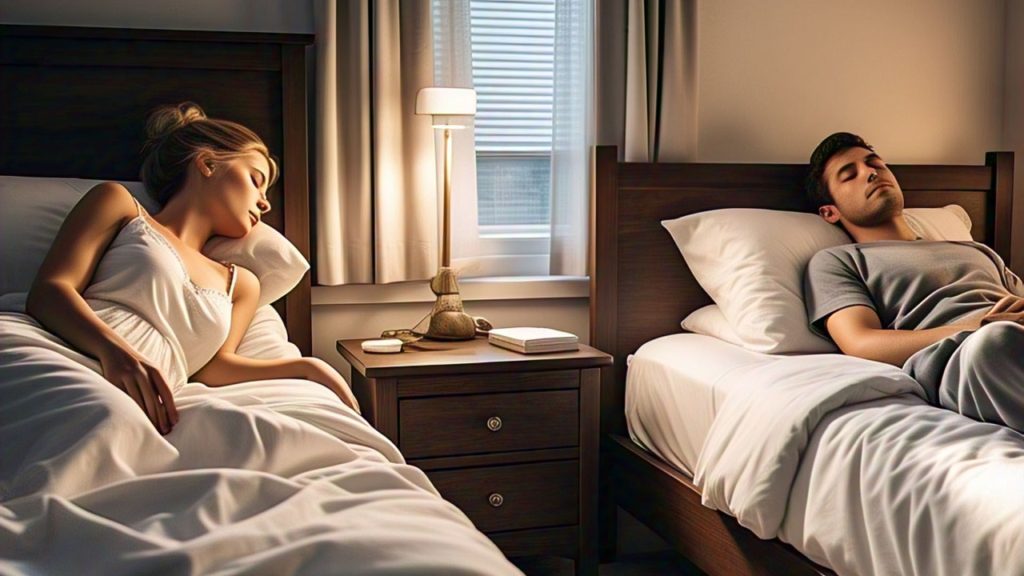

Sleep is that pleasant moment when we rest in the comfort of our bed after a long day of work to regain our strength. The thing is, for some couples, it’s not the dreamed moment.
This is due to many reasons, including insomnia, sleep apnea (snoring), the use of mobile devices, and different schedules, among other causes. Now the question is: is it mandatory to sleep together if the quality of my sleep is affected?
The truth is that sleeping in separate beds is no longer synonymous with marital crisis. On the contrary, more and more couples are doing it, and it’s known as sleep divorce, a solution to this issue that increasingly affects many couples around the world and whose goal is to improve sleep quality.
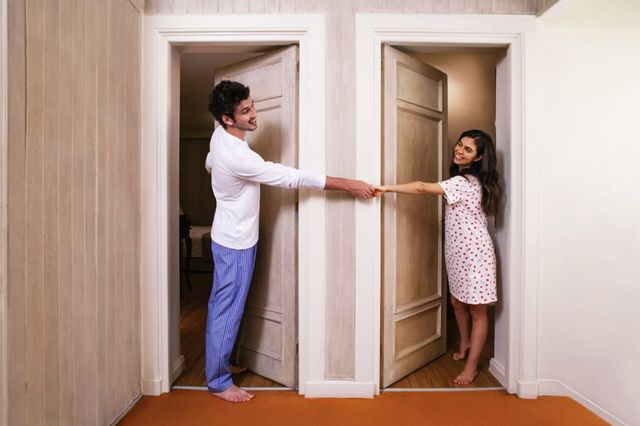
This term comes from the book of the same name by Jennifer Adams and Neil Stanley, an independent sleep expert and member of the European Sleep Research Society, in which they highlight the prioritization of rest over the tradition of sleeping as a couple, considered as the cornerstone of relationships in contemporary Western culture.
This trend poses a real challenge for couples, as it encourages sleeping in separate beds or rooms with the aim of reducing insomnia caused by constant movement, snoring, different temperature preferences, sleepwalking, or the other person’s sleeping habits.
The authors support their theory and explain that sleeping in separate rooms benefits individual health and could contribute to a healthier and happier relationship. Let’s remember that one of the functions of sleep is the elimination of toxins, memory consolidation, and rest for brain activity, among others.
Sleep habits vary with age and, in general, all humans have different habits and customs when it comes to sleeping, as explained by the creators of the “sleep divorce”:
“While in prehistoric times early humans slept in groups for safety reasons, sleeping separately was also customary in pre-19th-century Europe, especially among upper-class couples who had enough space for extra bedrooms. Most lived in castles and mansions. In fact, sleeping as a couple was a practice reserved for procreation”.
With the industrial revolution, sharing a bed with one’s spouse became the norm, because when families migrated from the countryside to the city, couples were forced to reduce the amount of space in their homes.
This information from our ancestors confirms that sleeping as a couple is a relatively new custom in Western marriages, but one that wasn’t adopted socially for its physiological benefits necessarily.
And although some couples choose to sleep separately for reasons related to comfort and find great benefits in their decision, which is still stigmatized by some, for other couples it remains pleasant to share the same bed.
A study conducted by the University of Arizona in 2022 showed that sleeping with a partner is associated with improvements in stress levels and, overall, benefits the mental health of both partners.
However, as with anything new, we must question the pros and cons:
Pros: you can develop regular, deep sleep, which directly influences your physical and emotional health and improves your mood. Additionally, this promotes healthy cohabitation with your partner, as arguments decrease.
Cons: possible loss of intimacy. For many couples, due to their routines, bedtime is one of the few opportunities they have to talk and connect, however, this leaves less time for individual quality time.
Solution: experts recommend finding other ways to share quality time to compensate for this nighttime distance.
According to another study conducted in 2023 by the American Academy of Sleep Medicine (AASM), more than a third of respondents in the United States acknowledged sleeping occasionally or regularly in separate bedrooms from their partners in order to improve sleep quality.
The research reveals the percentage of couples who sleep separately according to each generation:
- Millennials (born between 1981 and 1986): 43%
- Generation X (born between 1965 and 1980): 33%
- Generation Z (born between 1997 and 2012): 28%
- Baby boomers (born between 1946 and 1964): 22%

Young people are more clear-headed about the issue and don’t make a big deal out of sleeping separately; “if it’s for the benefit of both of us, why not do it?” However, this isn’t something that works for everyone.
Experts confirm that each couple must assess what suits them best, whether to sleep together or apart, and whether this brings them physiological benefits or not, without taking social norms into account.
Before making the decision, it’s important to try it out for a week to see if there are improvements in sleep quality and, therefore, in mood and cohabitation.
The idea is that both partners agree, because if one of you doesn’t want to, it will not work and will only cause resentment.
It should be clarified that “sleep divorce” only applies to the bedroom; the romantic relationship remains intact. This is this and that is that. Sleeping separately doesn’t mean loving each other less, but rather resting better in order to live together and with more passion #sinrecato.
Traducción del español: Catalina Oviedo Brugés