

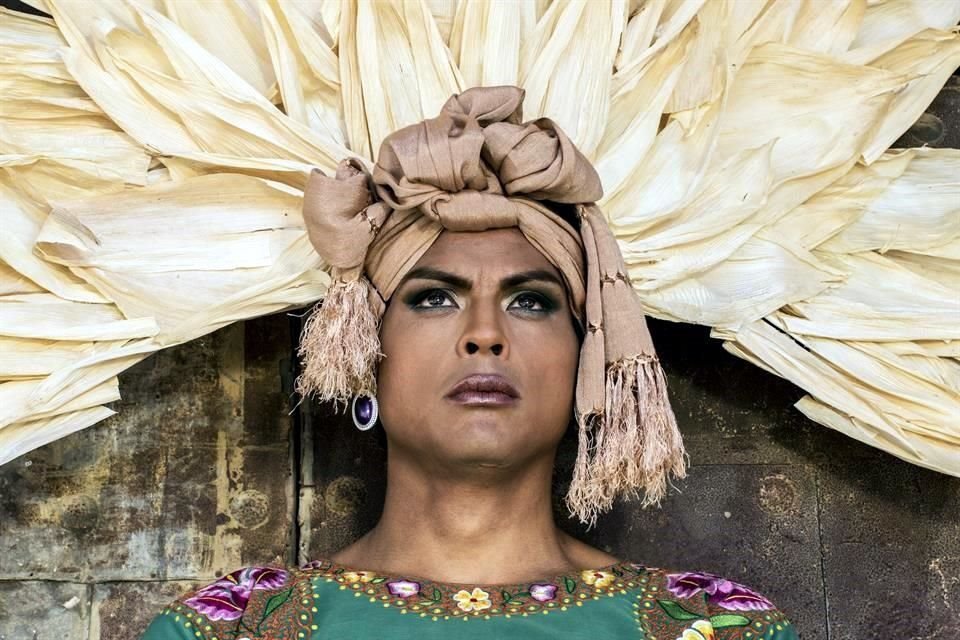

In Tehuantepec, Oaxaca, Mexico, there are the muxes, also known as the third gender. Before colonialism in Mexico, as with other indigenous people of the Americas, gender was not limited to the binary concepts of man and woman, but encompassed less simplistic concepts.
The muxes belong to the Zapotec culture, whose language lacks masculine or feminine pronouns and instead uses neutral ones, so there’s no “he” or “she.”
According to the National Autonomous University of Mexico, UNAM, as of 2019, there were nearly 3.000 muxes registered in the Isthmus of Tehuantepec region. In simple terms, muxes are defined as people who were assigned male at birth but who adopt roles stereotypically assigned to women.
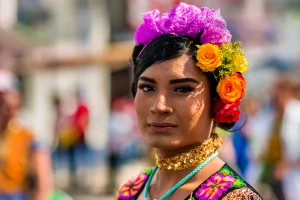 And while this definition brings us closer to the idea, the reality is that there’s no specific way to define muxes or their gender expression. Just as some may dress in the traditional clothing of women from the Isthmus of Tehuantepec, there are also others who wear clothing considered masculine.
They may use the name they were given at birth or change it, and they may even refer to themselves using masculine or feminine pronouns.
“It’s hard to describe who a muxe is. Basically, we can say it’s anyone who was born male but doesn’t act in a masculine way,” says Lukas Avendaño, who identifies as a multidisciplinary trans muxe performer.
In their community, they are considered a blessing to the family, as they’re generally the ones who run the household and care for the family, while the men go out to perform daily activities such as farming and fishing, and the women sell their handicrafts.
Another role of the muxes in the family is that they are the ones who care for their parents in old age when they can no longer fend for themselves, hence, most aren’t allowed to marry or have romantic relationships.
Muxes are an important part of families and festivities, one of which is ‘Las velas muxes’, a cultural celebration that drives the local economy. As for their attire, muxes wear the traditional huipil, a typical dress of the Isthmus consisting of a long skirt decorated with flowers, which they complement with jewelry.
Amaranta Gómez Regalado, a muxe activist and social anthropologist, explains how her identity came to be: “I knew I was a muxe, like most of us, since I can remember, and it was during my adolescence that I demanded to be accepted as such. I chose the name Amaranta after Amaranta Buendía, from One Hundred Years of Solitude, and it was almost a premonition, because later I had an accident in which I lost my arm, just like Buendía.”
And although Amaranta thinks it may seem that they are fully accepted by the community because muxes have existed for many years, the reality is quite different.
“I’ve always said that the only difference between accepting a gay or transgender person in Buenos Aires or Mexico City and accepting a muxe in the Isthmus is that the process of acceptance takes place, which is not an individual, family, or the immediate community’s matter, but rather a collective one,” she says.
Some myths have arisen around muxes, such as the one claiming they are considered a source of good luck for the community. Regarding those myths that aren’t quite accurate, Amaranta says:
“This myth stems from foreign perspectives, because they find it hard to believe that Indigenous populations engage in erotic practices. That’s why the HIV epidemic in our communities has been ignored. For years, we’ve been working through muxe organizations on public health policies to raise awareness and address the needs and sexual diversity of our community.”
In the beginning, muxes didn’t openly dress as women. Even today, while some muxes dress as women all the time, others don’t adopt women’s clothing.
The first signs of cross-dressing emerged in the 1960s and 1970s, when muxes began wearing very colorful clothing, loose blouses, and floral adornments when they went out in public. This became a dual process of acceptance: on one hand due to sexual orientation, and on the other, due to the inclusion of diversity in clothing.
In the 1980s and 1990s, cross-dressing was freely expressed, partly due to gay culture in the media, as that was when drag shows began to appear, and the muxes were also influenced by this atmosphere.
Regarding modern times, Amaranta explains how the muxes have adapted: “Modernity has adapted to our customs, not the other way around. In the early 1990s, a new generation of leaders that put women’s rights, environmental protection, the defense of our music and literature, and support for sexual rights, diversity, and the fight against HIV on the agenda emerged.”
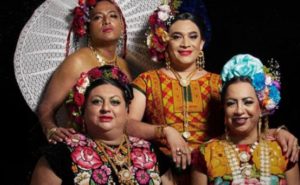 In 1997, the collective ‘Binni Laanu’ and the group ‘Las intrépidas contra el SIDA’ were founded, both muxes organizations focused on promoting sexual rights and HIV prevention.
Today, muxes form temporary partnerships with other men. This is because stable, long-term relationships are not very common, and it’s quite rare for them to form partnerships with cisgender women.
In the traditional family, the mother considers the muxe “the best of her children” because they don’t abandon their parents during life’s difficult moments, such as old age and illness. To their mothers, they represent financial security and moral support.
There is no doubt that muxes play a vital role in their communities, and yet we can see that, unfortunately, discrimination is a common thread in these diverse spaces.
That is why, as we kick off Pride Month, let’s remember that the most important role we can play is that of allies to the community and advocates for tolerance and respect, because equality shouldn’t be limited to June, it should be a year-round commitment.
Traducción del español: Catalina Oviedo Brugés